Pages

Showing posts with label Anti-Discrimination Law. Show all posts

Saturday, August 4, 2012

Equality for everyone, but please no politics!

Okay, so I liked this topic and spent a lot of time figuring out what I wanted to say, so hopefully I can make some kind of sense.  Discrimination has been a natural part of our history, based on race, gender, and other qualifications.  Many people have participated in discrimination even without consciously realizing it, by their actions against certain people.  Laws have been set up for lowering the amount of discrimination that is apparent in our society, and they have had varying amounts of success.

I don't know much about individual anti-discrimination laws, but they seem to all relate to giving minority groups more rights, correct?  Also, the definition of a "minority group" is a little fuzzy to me.  Why does women count as a minority group?  Aren't there just as many women as men, or is my perception of our population just majorly screwed up?  I don't know, I could be wrong, I have no idea.  I understand Hispanics or blacks in the United States being a minority group, because there is a  lesser percentage of them compared to the whole.  But isn't the gender ratio relatively equal?

So, I also don't really understand feminists who are obsessed with getting absolutely equal rights and then get pissed when the men fire back at them about things like maternity leave.  I don't really get that, but then I also have no idea about the discrimination in the workplace, which is what I think people are generally getting at when they are talking about such issues.  I think that if is isn't really a big issue for you, don't worry about it.  It's not really worth all the fuss to just get a raise or something just because of being a woman, instead of just taking it.  But then, I'm a really easy-going person and don't care much about working politics.

Races are also an interesting discussion.  Due to the lovely racism prior to the Civil War, we seem to still have a general spat between blacks and whites, even though most people have gotten over it all.  It seems to have gone crazy, with a fuss being made when whites do something racist towards minority groups even if there are cases of the opposite happening.  Or maybe that's just what you hear more of, I don't know.  I think the laws pertaining to races should be equal, just on principle.  I have no idea of they are or not, but they should be.

Now we get to sexual orientation.  I think the Chick-Fil-A deal is a bit worn out by now, and I won't go into that at all.  I personally think that non-strait people should have all the same rights and freedoms and such that straight people have.  It should just be like that, and there shouldn't be a major fuss about it.  I could probably go longer on this, but I won't for the sake of everyone reading this post.

So hopefully that wasn't too ramble-y and chaotic.  Enjoy reading the news topics that every is going to be posting next week!

Friday, August 3, 2012

Harassment is never okay.

Hello, everyone. So, like, um, everyone here, I'm also white and (I think?) middle class. I'm also a chick. I believe we've made this part clear.

That said, despite whatever class I may be in, I kind of grew up in the ghetto, but to be honest, didn't really realize it until I started going to school outside of it. I remember looking around near the end of my 5th grade year and noticing that I was literally the only white person in my class. I can't tell you if that's an accurate descriptor of how my entire elementary school education went, because I honestly don't remember. I didn't notice or care what race anyone else was. It didn't make a difference because I was tiny and didn't care about such things.

Honestly though, to me, it really just feels like discrimination based on race is an issue that just isn't from our time. I don't feel like I've passed judgments based on race nor do I really feel like anyone I know has. Because of this, I really feel like laws meant to "level the playing field" based on race are really superfluous. Obviously, we shouldn't get rid of anti-discrimination laws. There needs to be a legal basis for persecuting the kind of jerkfaces who would make decisions that way, but I just don't think it's widespread enough to require things like affirmative action to get there. John brought up the idea of equal opportunity employers and that's great, so I don't understand why there are practices that explicitly take into account things like race and gender.

The fact is that whether you are black, white, hispanic, Asian, or whatever race you identify as, you should be judged by the qualities you have and not what race you are. That said, there are definitely people that are at a disadvantage. It is so much harder to go from a family that has never gone to college and expects you to go straight to work after (or during) high school to a college education. That is a hard road that requires a lot of work and that sucks, however, that road is just as hard regardless of what race you are. If you are white and impoverished, that doesn't make you less impoverished. Basically, as far as leveling the playing field goes, I think it can be necessary, but I really think the factors that need to be leveled might be race-corrolated, but that's certainly not what they should be based on.

Unfortunately, I do think there's a bigger issue that America has today regarding discrimination, and I think that that's discrimination based on gender. In case you haven't gathered by now, I'm a girl majoring in computer science, which is a heavily male-dominated field. The problem is that while being a different race doesn't really affect anything, being a different gender does (a bit). Females get pregnant (Guys do not). Societally, females are more likely to be stay-at-home parents than males are. Honestly though, I really feel like the major problem is just the way people treat gender relations. Societally, there are a lot of differences between what men and women are expected to be, and a lot of them are crap. For example, there was a recent controversy about a woman who entered a fighting game tournament and eventually quit because of being sexually harassed. When asked for comment about it, the coach actually said that "the sexual harassment is part of our culture, and if you remove that from the fighting game community, it's not the fighting game community."

Obviously, you can find horror stories anywhere about any discrimination, but this seems so much more widespread. Genders are different and I don't think we as a society have really moved past that people can be whatever they want to be (or be into whoever they want to be). I'm a programmer and I feel like because I'm a girl, I have to work harder and be better than my male counterparts because I'm absolutely terrified of being hired just because I'm a chick. I remember when my friend got into college with me I was so excited, not just for him, but because that meant that someone with similar qualifications to me was accepted into the same program. And while I guess it's hard to argue against something that makes me work harder and be better, that's just not something I should have to be afraid of.

I firmly believe that in a lot of respects (and as cheesy as it sounds), diversity is its own reward. If you're working on designing a game (I admit I have a bit of a narrow focus), you want as many different ideas and viewpoints as you can. If you were constantly surrounded by the people you grew up with and went to school with, then how much would you really be challenged and grow? I believe that there are so many advantages to casting as broad a net as possible and I believe that there are qualified people in just about all of those categories. However, if you're not qualified for a job, you shouldn't get it solely on the basis of being the token [insert minority here].

Thursday, August 2, 2012

What does "level playing field" really mean anyway?


Continuing with the pattern— I am a white female and, like many others, I come from a middle class background.  I wish I had thought to share more about my background sooner, because I think that our circumstances play a great role in shaping what our opinions.  It kinda seems like good stuff to keep in mind when you read anything.  On the issue of anti-discrimination law, I think that as long as discrimination exists, anti-discrimination laws need to exist.  I know that I’m stating the obvious, but this is pretty much common ground that reasonable people can agree upon.  But, the question over whether our current anti-discrimination laws working too hard or not working hard enough? That’s a bit more complicated.

In some cases, anti-discrimination laws can help to level the playing field by creating “equal opportunities”.  Sadly, an outside force cannot really create equal opportunity; there are just too many factors that can’t realistically be addressed.  A teacher at my high school once told my class about a struggling student who was in one of her classes a long time ago.  This student rarely did his homework, he slept during class, and he performed poorly on tests and quizzes.  By this point, I was wondering what this kid’s issue was.  Why didn’t he go to sleep at home and actually try to pay attention during class?  So then my teacher told the class that when she talked to the student about his performance, he told her that he was rarely able to get a full night’s sleep because his dad would wake him up at one or two in the morning and get him to help with some kind of overnight work related to his job, and that’s why he had a hard time staying awake in class.  Now, I have no idea if this story was true or not, but it sounds pretty plausible for the time and place that it supposedly occurred.  Long story short, the kid received tutoring and he was able to pass, but he certainly wasn’t about to head off to college, because his dad needed him at home.  So even though some factors can be addressed, we can’t put anyone on true equal footing, and that’s something that we need to keep in mind.  

Anti-discrimination laws can also open new loopholes for those looking to gain the system, and often times those who the laws are set up to help aren’t receiving the benefits they should.  I know that loopholes can be found within any set of laws, but I’ve seen far too many people take advantage of “equalizers” that they didn’t really need just because they knew how to twist the facts in order to work the system, and they end up taking away from someone who really could have used the benefits.  That, and sometimes the people who benefit from anti-discrimination law are able to take their benefits too far, and that’s not good either.  Behold, a new can of worms is opened.  

To echo what Brandon said earlier this week, it seems that a lot of anti-discrimination laws aren’t really solving issues so much as they’re providing quick fixes to problems.  I agree; if we really want anti-discrimination laws to work, then we have to look at the root of the issue.  I think that the terms of many anti-discrimination laws need to be refreshed to ensure that the laws are serving their purpose as best they can.        Anti-discrimination laws will never be able to do what we really need for them to do, that is, to end discrimination or create an environment where discrimination cannot exist, anti-discrimination laws are definitely necessary in a world in which discrimination exists.    

Wednesday, August 1, 2012

After all, death discriminates against no one.

I suppose I'll follow the trend here and give a bit of background info about myself, and my status, before we get started with my thoughts on this week's topic.  I'm white, and... well, I think that my family is upper-middle class.  I'm really not sure, to be honest, because I have a lot of conflicting things in that respect.  For lack of a better solution, though, I'm just going to go with that.

Anti-discrimination laws are something that I find fairly difficult to discuss, because I find it pretty hard to track the impact that they have (or the extent to which they're followed).  Most of my experience with these laws are going to come from my job, as I've dealt with the hiring (and firing, sometimes) of new employees for the last 6+ years.  I'm not sure if I'll be able to come up with any thoughts outside of that particular box, but I'll try, at least.

Equal opportunity.  I really didn't understand the impact that those two words had until I started doing interviews and hiring people to work.  For anyone unfamiliar, being an "equal opportunity employer" mandates that you don't discriminate for or against applicants based on any non-essential traits that may exist (race, gender, orientation, etc).  What does this mean for employers?  Essentially, it means that you take the necessary steps to ensure you're following those rules and protecting yourself.  My place of employment has a very structured interview guide, and several of the questions on it are ridiculous.  Nonetheless, I use that guide with every single person that I interview.  Why?  Because having that constant is the first step in providing equal opportunity.  If you're asking every applicant the same questions, then there's no favoritism, no "free rides"... the decision is (or should be, anyway) based off of the applicant's answers to the questions. I once had an applicant threaten me with a lawsuit, because I hired another person over them - they claimed that I was discriminating against them, based on their race.  I invited them to do so, and nothing came of it.  In that respect, I would have been able to prove that I was following the law, and within that scope, I think that the laws do a fantastic job of ensuring equal opportunity - when they're followed.  Compliance is something that each individual has to take ownership of, and I feel comfortable in saying that it's not a priority for a lot of people.  I don't see an effective way to change this, however, without instituting some regular review of the hiring processes for every company in existence.  That's not likely to happen.

I've never really run into any issues with employees complaining about not getting opportunities, either - not based on anything discriminatory-wise, anyway.  I've trained a lot of employees, and I've promoted a lot of employees, and there have been members of multiple races within that group.  Again, I think it's entirely possible that there are some people out there who give more opportunities to people based on factors that they shouldn't, and I agree that it's wrong - but I don't see a way we can effectively monitor that sort of thing and stop it (proactively, anyway).

What groups should be protected by anti-discriminatory laws?  All of them.  In my opinion, discrimination is most commonly thought of as white people discriminating against other races.  That may be true in some cases - but not all of them.  The truth of the matter is that everyone has the potential to discriminate against everyone else, whether they're a different race or not.  I was discriminated against in the 11th grade by my Marketing teacher, because I steadfastly refused to join DECA (an international association of marketing enthusiasts, students, whatever).  I was the only member of the class not to join, and so I kept the teacher from hitting the 100% enrollment mark that she so desired - and so I was discriminated against.  My completed assignments were marked down for no reason, I was forced to stay after class just to use the shared printer... that class was absolute hell for me.  Did I deserve to be discriminated against?  Not at all.  Would bringing it to the attention of the authorities (the principal, school board, somebody) have helped?  Maybe, maybe not.  My point is that everyone is susceptible to discrimination, and everyone is capable of discriminating.  It's up to each person to determine how they'll act (or react) in any situation.

I got kind of off-topic with that, and I apologize for that.  My thoughts, basically, are that anti-discrimination is a thing that everyone in the world should embrace and practice.  Do I think it will happen?  No.  I also don't think that laws can be but so effective in making it happen.  I briefly considered whether an extreme law might help  - for example, stranding a diverse group of people on an island for a month, and forcing them to try to work together to survive.  But realistically, I think that would end in bloodshed and tribal wars.  Discrimination is an unfortunate part of the world, and everyone would be better off if it didn't exist.  If you have any fantastic ideas about how to end it, write your local congressman or senator.

Random thought for (hopeful) comments - if I attempted to start a cable TV channel based around white music and entertainment and was denied, would I have a case for discrimination, given that such channels exist for other races?

Tuesday, July 31, 2012

Equal Opportunity is Awesome

Like Kathleen, I should preface this by stating a few things about my background. I'm white. I was born into an upper middle class lifestyle. I'm male. I've had a lot of opportunities for success in my life, and I feel like I've made an effort to take full advantage of them.

I'm going to primarily focus on the issue of gender, because I have incredibly strong (some may even call them extreme) opinions on issues of gender equality. Those of you that read my personal blog have already heard a lot of what I'm about to say before, but hopefully this'll be a little more focused and organized.

A while back, there was a wonderful constitutional amendment that nearly got passed. By that, I mean that the only thing left was for three states to ratify it, and it would've been official. It was called the Equal Rights Amendment, and this is how it went:


Section 1. Equality of rights under the law shall not be denied or abridged by the United States or by any State on account of sex.
Section 2. The Congress shall have the power to enforce, by appropriate legislation, the provisions of this article.
Section 3. This amendment shall take effect two years after the date of ratification.


I don't know about you, but this sounds like a pretty kickass idea to me. I mean, what could go wrong? It couldn't be much more explicit in saying, "Discrimination based on gender is bad. Stop that." Why would people choose not to ratify it?

The answer to that is rather heartbreaking: people didn't actually want equal rights based on gender at the time, just protection for women. The possible implications of this amendment seemed absolutely absurd at the time. Women being drafted? Men being treated as equals in issues of custody of children and alimony? Worst of all, same sex couples being allowed to get married?

...Yeah, I kind of think that's all a load of shit. Wanting to not lose your special privileges is a terrible reason to fight against the equality that you claim to want so badly. Honestly, this is why most feminists today just kind of piss me off. I love the idea of equal rights, but equal doesn't mean, "Women should have all of the same rights as men... plus special rights that only women should get."

My issue with most forms of anti-discrimination laws is that they don't really seek to solve the problem as much as provide a quick and dirty patch to try to make the injustices on either side cancel out. This is a poor strategy, and I really think that the best idea for handling that is to try to start everyone off with a blank slate as much as possible. Maybe it's just because I've been fairly privileged, but I honestly believe that we all make our own successes and failures. Maybe those things come a little more easily in certain circumstances, but I really feel like the ultimate result is largely affected by our own actions.

However, one of the most tragically omnipresent issues for any minority group still existing today is the issue of hate crimes. People are terrible. People have a tendency to harbor discomfort toward that which is different, and because of this, people have the potential to be full of irrational hatred toward a group or idea. Because of this unfortunate piece of human nature, hate crime laws are still necessary. Special measures do need to be taken to prevent harassment based on race, religion, age, gender, sexual orientation, disability, social standing, and more. It's a sad truth, and I hope that we as a society can overcome it someday, but until that day, we need laws to protect these groups.

The most important point that I think I can make is that we really just need to do about discrimination is to figure out how to handle it on a personal level. If you find yourself discriminating irrationally based on one of the above factors, you need to make an effort to change your ways. If you see your friends or family doing it, you should try to educate them and get them to change their ways. If you find yourself becoming a victim, come out of it stronger by defending yourself and demanding equality. Most importantly though, you need to understand that you're not perfect, and you need to not be a self-righteous or self-important asshole. As long as you follow these general guidelines, you're doing your part in a fight that will hopefully be irrelevant in the future.

Monday, July 30, 2012

It's a Matter of Privilege

I am a white female from an upper middle class family. Do i think that Anti-Discrimination laws are still necessary? Yes, I do. Do I think that I have the authority to pass judgement on such laws? Not so much. I suppose my mind is more on matters of race than other matters of discrimination, and perhaps I will address those after I have addressed race.
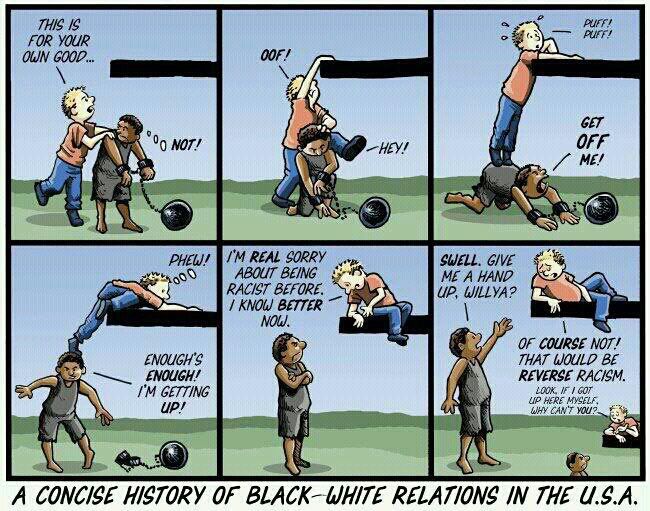
I think I will start with this comic that I found a little while ago, and had saved waiting for this topic to come up:


Over the past months I have exploring more into racial stuff and the issues of race today. It started back with the Whitewashing of the cast of The Last Airbender (from which the site Racebending.com was founded, which I find as a fascinating education on racial issues in Hollywood), and has been a gradual presence in the internet places I lurk at. But from what I have gathered, as a white person, I am privileged. I have less of a right to speak about racial discrimination because I can not understand and therefore I cannot pass judgement. From what I gathered persons of color still see racial discrimination as a problem, and therefore I believe that they are. 


I admit that at the concept of quotas still bothers me, because I like the idea that a person should be able to succeed by their own merit, not because of their skin color. But we do not live in a color blind world. Saying we should is great, but we don't and therefore Anti-Discrimination laws are still necessary. 


I was just in California, Los Angeles to be exact and it was really strange. I have lived pretty much all my life in a white dominated neighborhood and here was an area that could tell I was out of town because I was white. I felt out of place and wondered if that was anywhere similar to how minorities feel. If so, then Anti-Discrimination laws are needed because no one should feel out of place because of their skin color. 


Before I move on, I remembered one post I saw on Racebending's tumblr page (link here). It interested be because I never realized the degree of decoloring (for lack of a better term at the moment) was done in entertainment magazines and photos, and I think it speaks to the issues of race that are still present in our society. 


And I think that is all I will say on this angle of the topic and move on to my feelings on discrimination based on gender. 


As a female, I do believe I have more of a right to speak on this topic. I may have had more feelings back when it was politically more of an issue and laws and discussion concerning birth control and abortion were being made, but still I stand that men should not have the right to make decisions that specifically concern women. This topic is more concerning Anti-Discrimination laws (which are needed especially in concerns to pay), but the issue of women's health and laws pertaining to it fit into such discrimination. It's just that in this case Anti-Discrimination laws are not the answer, but that laws restricting it should stop. 


I will link a short story that I read back when discrimination against women's health was more of in the light issue, which was when the story was written. ILU-486 short story about a dystopian future with a summary that reads: "In the not-so-distant future of Virginia, the Personhood Act has outlawed abortion and chemical birth control. That doesn’t mean they don’t exist, though."

As a women, gender discrimination, especially when it comes to my health, bothers me a lot more. It's inevitable since it is affecting me. I think the fact that a equal pay act has not been passed by Congress, even though there have been attempts too, speaks to the need for it. There are facts all over the internet that show the earning differences that exist between men and women.

I remember reading somewhere that this difference, that women are overlooked for a promotion was because they were seen as eventually becoming mothers and leaving work. That therefore a man was a better "investment" because they were more likely to stick around longer and make the company more money. Perhaps with more women choosing careers over being a mother, perhaps that mindset will change. Though perhaps I am just being too optimistic.

Sunday, July 29, 2012

Week of 7/29 - Anti-Discrimination Law

Hey all. Laura's away at Otakon for the weekend doing awesome things, so I'll be announcing this week's topic. I hope you aren't all greatly disappointed.

As long as people have had differences, they've been used as an excuse to look down on others. Be it based on class, gender, race, age, disability, sexual orientation, or whatever, it's been a part of society that laws have either existed to promote or prevent. This week, we're going to talk about laws that have tried to prevent it.

How effective are current laws in protecting minority groups from discrimination? What can be done to make these laws more effective? Do these laws go too far and end up infringing on the rights of majority groups? Which groups should be protected by these laws? Which shouldn't? How necessary are these laws in today's society? These are just some of the questions that we're going to try to address this week, along with talking about some of our own experiences with the subject.

As always, our discussion is primarily going to focus on policies in the United States, as that's where all of us are from, though there may be some international comparisons made.

Kathleen will start us off tomorrow, and I'll be back to weigh in on Tuesday. Can't wait to see what everyone has to say!