Like Kathleen, I should preface this by stating a few things about my background. I'm white. I was born into an upper middle class lifestyle. I'm male. I've had a lot of opportunities for success in my life, and I feel like I've made an effort to take full advantage of them.
I'm going to primarily focus on the issue of gender, because I have incredibly strong (some may even call them extreme) opinions on issues of gender equality. Those of you that read my personal blog have already heard a lot of what I'm about to say before, but hopefully this'll be a little more focused and organized.
A while back, there was a wonderful constitutional amendment that nearly got passed. By that, I mean that the only thing left was for three states to ratify it, and it would've been official. It was called the Equal Rights Amendment, and this is how it went:
Section 1. Equality of rights under the law shall not be denied or abridged by the United States or by any State on account of sex.
Section 2. The Congress shall have the power to enforce, by appropriate legislation, the provisions of this article.
Section 3. This amendment shall take effect two years after the date of ratification.
I don't know about you, but this sounds like a pretty kickass idea to me. I mean, what could go wrong? It couldn't be much more explicit in saying, "Discrimination based on gender is bad. Stop that." Why would people choose not to ratify it?
The answer to that is rather heartbreaking: people didn't actually want equal rights based on gender at the time, just protection for women. The possible implications of this amendment seemed absolutely absurd at the time. Women being drafted? Men being treated as equals in issues of custody of children and alimony? Worst of all, same sex couples being allowed to get married?
...Yeah, I kind of think that's all a load of shit. Wanting to not lose your special privileges is a terrible reason to fight against the equality that you claim to want so badly. Honestly, this is why most feminists today just kind of piss me off. I love the idea of equal rights, but equal doesn't mean, "Women should have all of the same rights as men... plus special rights that only women should get."
My issue with most forms of anti-discrimination laws is that they don't really seek to solve the problem as much as provide a quick and dirty patch to try to make the injustices on either side cancel out. This is a poor strategy, and I really think that the best idea for handling that is to try to start everyone off with a blank slate as much as possible. Maybe it's just because I've been fairly privileged, but I honestly believe that we all make our own successes and failures. Maybe those things come a little more easily in certain circumstances, but I really feel like the ultimate result is largely affected by our own actions.
However, one of the most tragically omnipresent issues for any minority group still existing today is the issue of hate crimes. People are terrible. People have a tendency to harbor discomfort toward that which is different, and because of this, people have the potential to be full of irrational hatred toward a group or idea. Because of this unfortunate piece of human nature, hate crime laws are still necessary. Special measures do need to be taken to prevent harassment based on race, religion, age, gender, sexual orientation, disability, social standing, and more. It's a sad truth, and I hope that we as a society can overcome it someday, but until that day, we need laws to protect these groups.
The most important point that I think I can make is that we really just need to do about discrimination is to figure out how to handle it on a personal level. If you find yourself discriminating irrationally based on one of the above factors, you need to make an effort to change your ways. If you see your friends or family doing it, you should try to educate them and get them to change their ways. If you find yourself becoming a victim, come out of it stronger by defending yourself and demanding equality. Most importantly though, you need to understand that you're not perfect, and you need to not be a self-righteous or self-important asshole. As long as you follow these general guidelines, you're doing your part in a fight that will hopefully be irrelevant in the future.
Tuesday, July 31, 2012

Monday, July 30, 2012
It's a Matter of Privilege
 I am a white female from an upper middle class family. Do i think that Anti-Discrimination laws are still necessary? Yes, I do. Do I think that I have the authority to pass judgement on such laws? Not so much. I suppose my mind is more on matters of race than other matters of discrimination, and perhaps I will address those after I have addressed race.
I think I will start with this comic that I found a little while ago, and had saved waiting for this topic to come up:
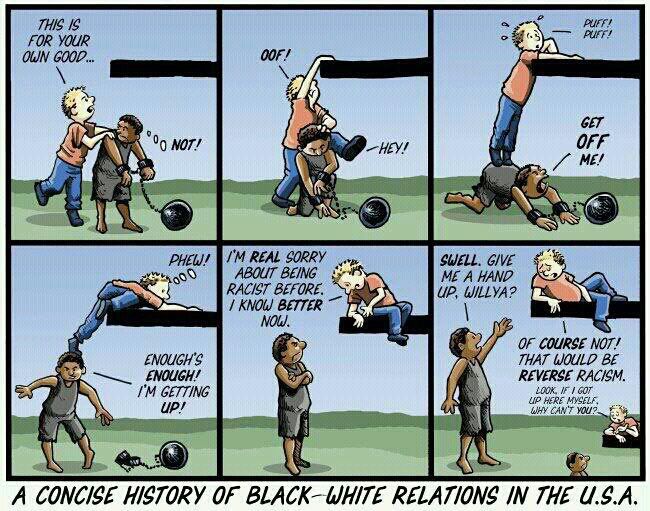
Over the past months I have exploring more into racial stuff and the issues of race today. It started back with the Whitewashing of the cast of The Last Airbender (from which the site Racebending.com was founded, which I find as a fascinating education on racial issues in Hollywood), and has been a gradual presence in the internet places I lurk at. But from what I have gathered, as a white person, I am privileged. I have less of a right to speak about racial discrimination because I can not understand and therefore I cannot pass judgement. From what I gathered persons of color still see racial discrimination as a problem, and therefore I believe that they are.
I admit that at the concept of quotas still bothers me, because I like the idea that a person should be able to succeed by their own merit, not because of their skin color. But we do not live in a color blind world. Saying we should is great, but we don't and therefore Anti-Discrimination laws are still necessary.
I was just in California, Los Angeles to be exact and it was really strange. I have lived pretty much all my life in a white dominated neighborhood and here was an area that could tell I was out of town because I was white. I felt out of place and wondered if that was anywhere similar to how minorities feel. If so, then Anti-Discrimination laws are needed because no one should feel out of place because of their skin color.
Before I move on, I remembered one post I saw on Racebending's tumblr page (link here). It interested be because I never realized the degree of decoloring (for lack of a better term at the moment) was done in entertainment magazines and photos, and I think it speaks to the issues of race that are still present in our society.
And I think that is all I will say on this angle of the topic and move on to my feelings on discrimination based on gender.
As a female, I do believe I have more of a right to speak on this topic. I may have had more feelings back when it was politically more of an issue and laws and discussion concerning birth control and abortion were being made, but still I stand that men should not have the right to make decisions that specifically concern women. This topic is more concerning Anti-Discrimination laws (which are needed especially in concerns to pay), but the issue of women's health and laws pertaining to it fit into such discrimination. It's just that in this case Anti-Discrimination laws are not the answer, but that laws restricting it should stop.
I will link a short story that I read back when discrimination against women's health was more of in the light issue, which was when the story was written. ILU-486 short story about a dystopian future with a summary that reads: "In the not-so-distant future of Virginia, the Personhood Act has outlawed abortion and chemical birth control. That doesn’t mean they don’t exist, though."
As a women, gender discrimination, especially when it comes to my health, bothers me a lot more. It's inevitable since it is affecting me. I think the fact that a equal pay act has not been passed by Congress, even though there have been attempts too, speaks to the need for it. There are facts all over the internet that show the earning differences that exist between men and women.
I remember reading somewhere that this difference, that women are overlooked for a promotion was because they were seen as eventually becoming mothers and leaving work. That therefore a man was a better "investment" because they were more likely to stick around longer and make the company more money. Perhaps with more women choosing careers over being a mother, perhaps that mindset will change. Though perhaps I am just being too optimistic.
Sunday, July 29, 2012
Week of 7/29 - Anti-Discrimination Law
Hey all. Laura's away at Otakon for the weekend doing awesome things, so I'll be announcing this week's topic. I hope you aren't all greatly disappointed.
As long as people have had differences, they've been used as an excuse to look down on others. Be it based on class, gender, race, age, disability, sexual orientation, or whatever, it's been a part of society that laws have either existed to promote or prevent. This week, we're going to talk about laws that have tried to prevent it.
How effective are current laws in protecting minority groups from discrimination? What can be done to make these laws more effective? Do these laws go too far and end up infringing on the rights of majority groups? Which groups should be protected by these laws? Which shouldn't? How necessary are these laws in today's society? These are just some of the questions that we're going to try to address this week, along with talking about some of our own experiences with the subject.
As always, our discussion is primarily going to focus on policies in the United States, as that's where all of us are from, though there may be some international comparisons made.
Kathleen will start us off tomorrow, and I'll be back to weigh in on Tuesday. Can't wait to see what everyone has to say!
As long as people have had differences, they've been used as an excuse to look down on others. Be it based on class, gender, race, age, disability, sexual orientation, or whatever, it's been a part of society that laws have either existed to promote or prevent. This week, we're going to talk about laws that have tried to prevent it.
How effective are current laws in protecting minority groups from discrimination? What can be done to make these laws more effective? Do these laws go too far and end up infringing on the rights of majority groups? Which groups should be protected by these laws? Which shouldn't? How necessary are these laws in today's society? These are just some of the questions that we're going to try to address this week, along with talking about some of our own experiences with the subject.
As always, our discussion is primarily going to focus on policies in the United States, as that's where all of us are from, though there may be some international comparisons made.
Kathleen will start us off tomorrow, and I'll be back to weigh in on Tuesday. Can't wait to see what everyone has to say!
Saturday, July 28, 2012
Talking about death is sad.
 So this has been a really interesting (if sad) week of posts. I think everyone has brought up fascinating and informative ideas and I'm glad to be here to share my opinions.
First off, I agree wholeheartedly with Pendleton when she says that it's not up to us to legislate morality and personal opinions on morality are not bases for laws. On the flip side, laws are meant to protect the people. Personally though, I believe that there isn't any reason to make a law protecting us from ourselves. Laws are to protect us from other people (or other people from us, as the case may be).
That said, there are lots of factors to assisted suicide. A family member on life support can be a huge drain on a families resources, both financial and mental, and one might argue that if there is just about no chance of the person ever recovering (or recovering with serious brain damage), it would be more worth it to pull the plug. Others might argue that doctors can be wrong and if there is any chance then they should continue as long as they are able. I think that falls squarely into the category of personal choice. The person can't stay alive on their own so allowing the person to die naturally is not really assisted suicide. The same (in my opinion) goes for a Do Not Resuscitate order. If the person's body is already self-destructing, letting it do that is just the natural cycle of life and death.
Of course, one could argue that it's the doctor's job to mess with the natural cycle of life and death. Their job is to prolong life, which has led to an increase of a slew of diseases affecting the elderly. Obviously, this doesn't mean we should stop letting people practice medicine, but it does mean there are more things to consider than someone's body self-destructing.
For example, Brandon brought up the idea of Alzheimer's and how he'd hate to life as a shell of his former self. I fully agree. It must be terrible to live that way and I can say first hand how terrible it is to be around. They aren't the person they used to be, and that's terrifying, but at the same time...I don't think I'd want to die. I think life could still hold happiness. I personally really wouldn't want anyone to have to take care of me and deal with me like that but I don't think I'd want to die.
There was an episode of SVU that brought up the idea that "there is no such thing as a terminal mental illness" and that's both true and sad. If your body is working fine, your brain can be wreaking havoc and there just isn't a quantitative way to measure that. You can't measure quality of life and you can't say "Well, this is bad enough where you are eligible for assisted suicide but you just have to suck it up." There is no way to draw that line. I think if there are diseases where the person suffering has no effective treatment and desires assisted suicide, then it should be an available option after a certain waiting period. Obviously, this seems like a wide net, but I really mean this for only serious comprehensively life-affecting diseases. This is not for people with depression that can be treated.
As far as physical diseases go, I think the body really has its own way of dealing with things, but a slow, painful death is not something anyone should have to endure if it's the only future ahead of them. And even in situations where it might not be terminal, if it's not treatable (and I mean treatable, not curable), then it really seems like the person's choice as to whether or not they would like to endure it.
Health care is expensive and it seems almost immoral to me to force someone to pay for what I can only assume is ridiculously expensive health care (for such a presumably serious disease) just to prolong a life they don't want to live. If someone really wants to end their life, they can probably find a way, and I think giving them a humane option (after serious counseling and various other screening procedures) is the best thing to do.
Friday, July 27, 2012
Assisted Suicide: Does Legalization Do More Harm or More Good?
As far as my personal opinion goes, I’m not positive on exactly where I stand on the issues of suicide or assisted suicide. I don’t know if I think that it is our place as humans to decide when to end a life, even if it is our own. But then again, it’s not up to us to legislate morality either. However, legalizing assisted suicide does have its sticky wickets that we would have to deal with later. I’m sure you can tell that I’m still kind of going back and forth even as I write this post, but I promise that I’ll eventually get to a point if you hang in there with me.
Regardless of where I personally stand on this issue (I’m not entirely sure where that is anyway), there are a number of important things that need to be taken into consideration. The first thing that comes to my mind is the potential slippery slope that could come into effect if assisted suicide was legalized. What would the procedure be? What kind of opportunities would making this option legal open up to people with the wrong intent? I guess the ultimate question is whether legalizing assisted suicide would do more harm than good. And no one can completely answer that question.
The other major point within this issue is whether assisted suicide is necessary. Many of those who are against assisted suicide in cases of terminal illness urge patients to instead stop their treatments, take painkillers, and allow themselves to die naturally. Since I’ve never been close to anyone who had a terminal illness, I have no idea how or if this works. Then on the other hand, in many cases, it could save a family their much-needed money if their terminally ill family member wanted to use the option of assisted suicide so they could die peacefully and relieve their family of financial and emotional strain.
Another major thing to think about is the Hippocratic oath. I’ve never read the oath in full, but I do know when discussing this issue, that the primary section of this document up for debate is the affirmations that doctors make to “never do harm to anyone.” The way I see it, this phrase can be used to support either side of the debate depending on interpretation. “Harm” could be interpreted as purposefully killing someone (even if they asked you to do so) or it could be interpreted as continuing to keep someone alive against his or her wishes. It all depends on the kind of approach is taken, although I’ll admit the second interpretation is a bit of a stretch for even me.
As I said before, I don’t know exactly how I feel about the morality of assisted suicide, but I don’t believe it should be legalized or banned based on anyone’s opinions on the issue. That being said, there are legitimate facts and concerns that back each side of this issue; however, if I were to vote on the issue today, I would favor the option to legalize assisted suicide. Overall, I believe that this option would do the greatest amount of good for the most people. Taking precaution against any foreseeable foul play that could arise, terminally ill patients should have the option to choose if they want to peacefully end their lives to avoid any further mental, physical, or financial suffering.
Kelsey will be back tomorrow to wrap up the discussion of this week's topic. Thanks again for reading!
Thursday, July 26, 2012
If I Ever Get Alzheimer's, Shoot Me In The Face
To start off, thanks to John for covering for me yesterday. I had my wisdom teeth removed on Monday, and I've been kind of out of it ever since. Not 100% sure how much sense I'll be making, but I haven't taken any painkillers since late Tuesday night/early Wednesday morning, so I'm gonna give this my best shot.
The legality of this issue is a messy one, though really, I don't know if it should be. As Kelsey mentioned, there are a couple of states that allow it, and the conditions on it are pretty restrictive. Multiple doctors need to sign a form saying that you only have a few months to live, and then that's it. It seems like a pretty decent set of restrictions, after all, we can't have people running around getting poison from the doctor whenever they want. This seemed like an acceptable idea, and I actually wrote a research paper in favor of it in high school. However, as time as passed, other situations that it doesn't quite cover have left me less and less comfortable with it.
Most immediately, the issue of terminal illnesses that won't kill you immediately. As the title of this post suggests, the idea of dementia terrifies me. The idea of going on living as this empty shell of who I used to be is just... it's terrifying. I would hate to go on with life that way. It just sounds unbearable.
This may sound heartless, but I don't think that Do Not Resuscitate orders and refusing treatment are that different from straight up going the assisted suicide route. The only difference is that it's passive instead of active as a choice.
What it comes down to is that if somebody is ready to die, then they should have the legal right to do so. The mechanism used to enact that choice isn't nearly as relevant. Forcing people to go on beyond the point where they've ceased to really be people against their wishes isn't right, and I think the law needs to allow this option. I'm not really sure of the best way to adjust the existing law in states that allow it. Perhaps opening the option up to anyone with a terminal illness regardless of how long they have to live, but requiring them to sit on the decision for a certain number of months before they can actually do it? I don't know.
Well, that ended up being rather depressing. We'll be returning to our normal post schedule tomorrow with Pendleton, and again, thank you to John for posting early.
The legality of this issue is a messy one, though really, I don't know if it should be. As Kelsey mentioned, there are a couple of states that allow it, and the conditions on it are pretty restrictive. Multiple doctors need to sign a form saying that you only have a few months to live, and then that's it. It seems like a pretty decent set of restrictions, after all, we can't have people running around getting poison from the doctor whenever they want. This seemed like an acceptable idea, and I actually wrote a research paper in favor of it in high school. However, as time as passed, other situations that it doesn't quite cover have left me less and less comfortable with it.
Most immediately, the issue of terminal illnesses that won't kill you immediately. As the title of this post suggests, the idea of dementia terrifies me. The idea of going on living as this empty shell of who I used to be is just... it's terrifying. I would hate to go on with life that way. It just sounds unbearable.
This may sound heartless, but I don't think that Do Not Resuscitate orders and refusing treatment are that different from straight up going the assisted suicide route. The only difference is that it's passive instead of active as a choice.
What it comes down to is that if somebody is ready to die, then they should have the legal right to do so. The mechanism used to enact that choice isn't nearly as relevant. Forcing people to go on beyond the point where they've ceased to really be people against their wishes isn't right, and I think the law needs to allow this option. I'm not really sure of the best way to adjust the existing law in states that allow it. Perhaps opening the option up to anyone with a terminal illness regardless of how long they have to live, but requiring them to sit on the decision for a certain number of months before they can actually do it? I don't know.
Well, that ended up being rather depressing. We'll be returning to our normal post schedule tomorrow with Pendleton, and again, thank you to John for posting early.
Wednesday, July 25, 2012
“In the darkest hours we must believe in ourselves.”
 Surprise! I know that you were all expecting Brandon's post here, but...
... Wait, no, come back! I promise, he'll have his post up a bit later in the week. I'm just filling in due to extenuating circumstances (and painkillers).
So, assisted suicide. I worried for a while about this post, because I (among other people) wasn't sure if there would be much variance between the posts - but since we've opened it up from just the legality of the issue (thank you, Kelsey, for an amazingly awesome intro post), I'm much more confident.
Initially, I'll talk a bit about the legality of assisted suicide. Virginia is somewhat odd in its handling of assisted suicide - there's been no real decision made on the matter, for the most part. There's a statute which imposes civil sanctions on anyone involved in suicide, but the act isn't clearly defined as criminal. There's really not a whole lot to debate, there, besides potentially comparing it to other states' policies. The majority of the United States treats assisted suicide as an explicitly criminal act... which I don't necessarily agree with. Yes, you're aiding in the death of someone, but if it's in accordance with their wishes and desires, should it really be considered -criminal-? That's not for me to decide, though, so I'm going to leave the legality bit right there.
My personal feelings, on the other hand, run much deeper (and along many more confusing, twisted paths). First off, we'll look at "Do Not Resuscitate". I have absolutely no problem with this concept - at least in terms of illness, or other debilitating diseases. If someone is dying to an illness, and their body fails, then by all means, let them go. Our bodies are incredibly resilient, and if they go through enough to shut down, I think it does more harm than good in trying to force them to do even more. I understand that it's hard for people to look on, armed with the knowledge that they could keep someone they care for from dying... but I also believe that allowing nature to run its course in those instances is a good first step toward healing. I do want to re-empathize that this references only instances involving diseases and the like - if a fairly healthy person ripped off their oxygen mask, or something, then the line would move a fair bit. I think that refusal of treatment falls into this definition, as well - it's a patient's right to refuse medical treatment, and if their body naturally gives out as a result... well, that was their decision.
So what about non-immediate dangers? If someone discovers they only have a year left to live, should assisted suicide be permissible? On the one hand, having that kind of thing over your head can (I'm assuming) be a fantastic motivator to do the things you've always wanted to, and really live life to its fullest. But is there a specific timeframe where it's acceptable? If someone has a year to live, and they have no desire to "live it up", why shouldn't they be able to just end their life then, and save themselves (and potentially their family) from unnecessary bills and expenses? ... I don't think there's a correct answer here, necessarily, but I do believe that a concerted effort should be made to hold off on any form of suicide for as long as possible. Technology has the potential to increase quickly enough that what seems impossible right now could be semi-commonplace in a year's time. Is it likely to happen? Who knows? But if you can keep the hope of living on alive, shouldn't that be enough to keep you going?
Reduced quality of life... this one is pretty tough. Let's take a paraplegic, for example. A "normal, everyday" person somehow gets hit by a car and will be confined to a wheelchair for the rest of their life. Is this a situation where assisted suicide would be acceptable? ... Basing my own personal feelings off the idea above, I'd still have to say no. Yes, the quality of their life would have changed in a (potentially) negative fashion - however, this doesn't mean that their life would no longer have meaning. Look at Stephen Hawking. He started being affected by amyotrophic lateral sclerosis at age 20. It's common for people to pass away within 10 years of being diagnosed with the disease - he's had it for five times that, and he's still alive. If he had just given up and chosen to commit suicide after his diagnosis... well, I can't even really imagine how things would be different. If that's not a compelling case, I don't know what is.
The involvement of doctors is a bit more clear-cut for me. One of the most basic cornerstones for physicians through the years has been the Hippocratic Oath (though it's become less widely used). I believed that people operating under the Hippocratic Oath were sworn to preserve life however and wherever they were able - however, I think that my viewpoint has changed after reading multiple translations of the Oath. The original version includes these lines:
I will give no deadly medicine to any one if asked, nor suggest any such counsel; and similarly I will not give a woman apessary to cause an abortion.
But I will preserve the purity of my life and my arts.
The classic translation of the Oath changes the lines to the following:
I will neither give a deadly drug to anybody if asked for it, nor will I make a suggestion to this effect. In purity and holiness I will guard my life and my art.
And, finally, the more modern translation reads as follows:
If it is given to me to save a life, all thanks. But it may also be within my power to take a life; this awesome responsibility must be faced with great humbleness and awareness of my own frailty. Above all, I must not play at God.
I will remember that I do not treat a fever chart, a cancerous growth, but a sick human being, whose illness may affect the person's family and economic stability. My responsibility includes these related problems, if I am to care adequately for the sick.
The modern translation seems to provide some form of direction for the issue - it's an unfortunate truth that hospital care in our country is rather expensive, and a prolonged stay will almost certainly strain most people's monetary situations. At some point, you have to weigh what's potentially best for one person against what's potentially best for others. Am I advocating doctor-assisted suicide? ... Not intentionally. But I do think that they have a place in helping people make decisions about their health and life. That's their job, after all.
I think I've rambled on enough - I'm going to wrap up with a personal thought. In most cases, I'm personally completely against suicide as an option (if you can even call it that) for people. Suicide can seem like a quick fix for life's problems, but the reality is that the person usually just passes their problems on to other people - generally, the ones who care about them. I've been in situations where friends, family members, and even the people I've cared most about have contemplated (and attempted... and, once, successfully committed) suicide. The sense of loss that accompanies suicide is tremendous, and not something that I would wish upon anyone. I only describe myself as against the idea in "most" cases because absolutes are rarely correct - but I'm pretty close. The other posts so far have been pretty interesting, and I'm looking forward to reading the others as they come.
As always. thanks for reading, and feel free to post any questions, thoughts, or flames below.
Subscribe to:
Posts (Atom)